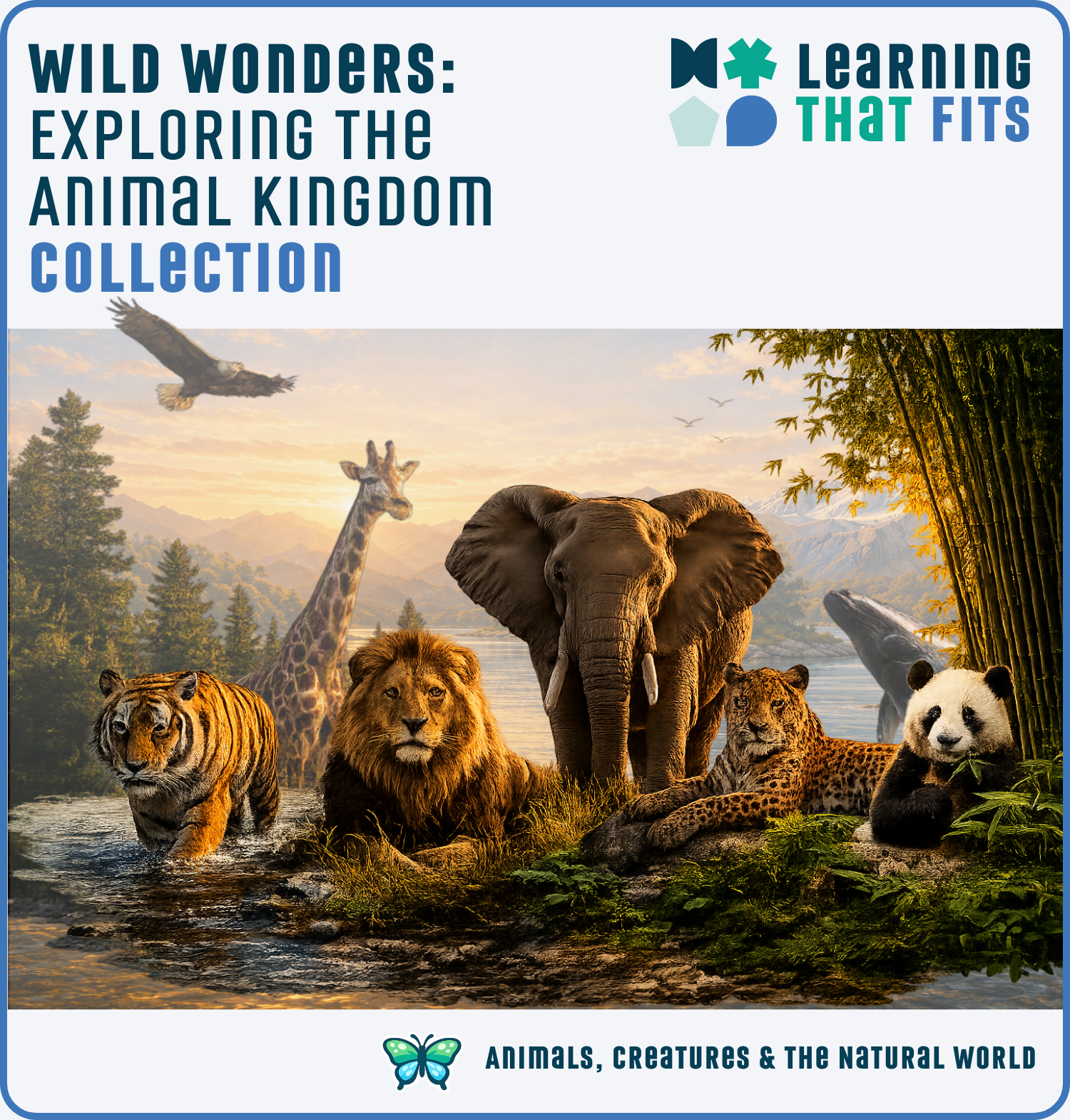
This Curiosity Collection provides a cross-curriculum exploration of the animal kingdom through science, geography, data investigation, and creative design.
Learners explore how animals live, survive, and interact with their environments while developing skills in observation, questioning, research, comparison, and creative communication.
Throughout the collection, learners investigate: animal classification, ecosystems and habitats, food chains and predators, adaptations and survival, world biomes and animal locations, comparing animal data and presenting ideas through models, maps, diagrams, and projects.
The collection is designed using inclusive learning principles, supporting diverse learning needs through self-paced exploration, clear instructions, flexible activity options, visual supports, and multiple ways for Wonder Seekers to engage, create, build, and reflect.
A Curiosity Collection includes multiple Wonder activities completed over several sessions.
Each activity introduces new ideas through exploration, investigation, and creative design, leading to a final project where Wonder Seekers combine what they have learned.
The Collection includes:
Each Curiosity Collection takes learners on a Wonder Learning Journey.
| Learning Area | Level, Code | Descriptor |
|---|---|---|
| Science | Level 3, VCSSU044 | Living things can be grouped based on observable features and can be distinguished from non-living things. |
| Science | Level 3, VCSSU045 | Living things depend on each other and the environment to survive, and their features help them live in different environments. |
| Science | Level 4, VCSSU058 | Living things have life cycles and can be grouped based on observable features and similarities. |
| Science | Level 4, VCSIS068 | Pose questions and make predictions about scientific investigations. |
| Science | Level 4, VCSIS070 | Represent and communicate ideas and findings using tables, diagrams, and simple reports. |
| English | Level 3, VCELY247 | Plan, draft and publish imaginative, informative and persuasive texts demonstrating increasing control over text structures and language features. |
| English | Level 3, VCELY246 | Read and view a range of texts and identify literal and implied meaning, main ideas and supporting details. |
| English | Level 3, VCELY248 | Use speaking and listening skills to share ideas and information. |
| English | Level 4, VCELY256 | Create informative texts using appropriate structure and vocabulary. |
| Mathematics | Level 3, VCMSP150 | Collect data, organise it into categories, and create displays such as lists, tables, picture graphs and simple bar graphs to answer questions. |
| Mathematics | Level 3, VCMSP149 | Conduct simple data investigations, represent data, and interpret results. |
| Mathematics | Level 4, VCMSP179 | Construct and interpret data displays including tables and graphs. |
| Mathematics | Level 4, VCMMG166 | Use measurement and comparison to describe size, distance, and features. |
| Humanities | Level 3, VCHHK070 | Identify and describe the characteristics of places, including natural environments, and how people and living things depend on them. |
| Humanities | Level 3, VCHHK071 | Describe how people use environments in different ways. |
| Humanities | Level 4, VCHHK082 | Describe how environments support living things and how they can change. |
| Humanities | Level 4, VCHHK083 | Identify the characteristics of different climates and environments around the world. |
| Technologies | Levels 3–4, VCDSTC025 | Generate, develop and communicate design ideas and plans using drawings, models and digital tools. |
| Technologies | Levels 3–4, VCDTCD027 | Use digital systems safely to create and communicate information. |
| Technologies | Levels 3–4, VCDSTS024 | Investigate how forces and materials can be used to create designed solutions. |
| The Arts | Levels 3–4, VCAVAE025 | Create and present visual artworks that express ideas, observations and imagination using a range of materials, techniques and processes. |
| The Arts | Levels 3–4, VCAVAR026 | Explore ideas and artworks from different cultures and times. |
| Critical Thinking | Level 4, VCCCTQ012 | Investigate different ways of sorting information and ideas, and use questioning and imagination to generate possible solutions. |
| Critical Thinking | Level 4, VCCCTR013 | Use creative thinking to explore possibilities and generate ideas. |
| Critical Thinking | Level 4, VCCCTR014 | Apply creative thinking to design and make solutions. |
| Personal and Social Capability | Level 4, VCPSCSE017 | Identify personal strengths and areas for improvement, and reflect on learning experiences to improve future learning. |
| Personal and Social Capability | Levels 3–4, VCPSCSE016 | Work independently and collaboratively to complete tasks and reflect on learning. |
Our guided learning journey that moves from curiosity to understanding. Each step
builds naturally, so your child can explore, think, create, and grow at their own pace.

Get orientated and understand the challenge, goals and what you’ll create.


Ask questions, explore different ideas and perspectives and gather inspiration.

Dig deeper into your ideas, test possibilities and build understanding.

Create, make and experiment using the skills and ideas you’ve developed.

Look back on your process and results, celebrate growth and consider what’s next.
Explore legends, creatures, and mythical worlds while building skills
Discover how animals live, adapt, and survive while learning about the natural world.
Use gaming worlds to strengthen problem-solving, digital literacy, and thinking.
Discover the science behind speed while developing skills in physics, measurement, and data.