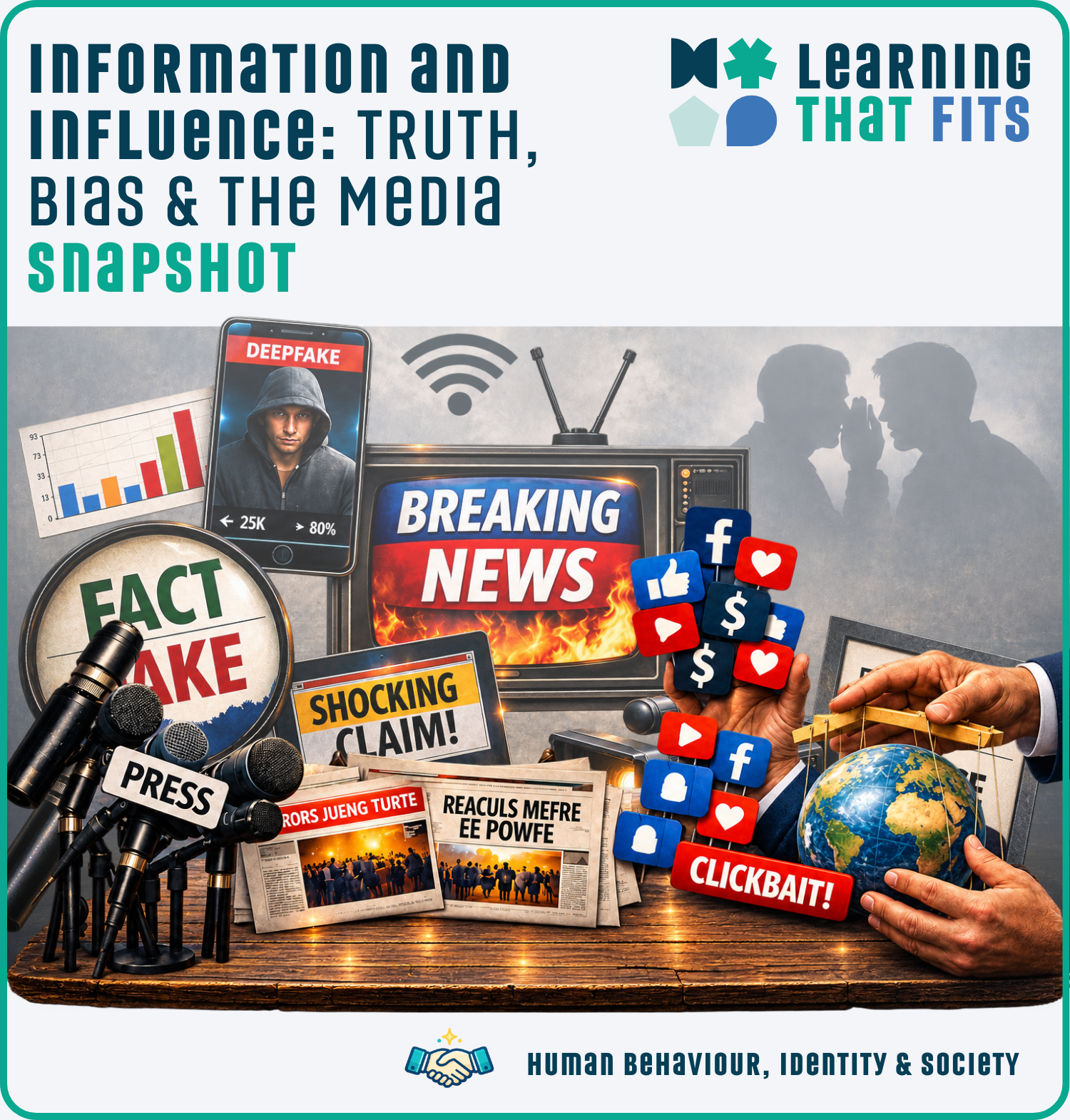
This Curiosity Snapshot provides a cross-curriculum introduction to truth, bias, evidence, media literacy, and the way information is created, shared, and evaluated in a digital world.
Learners explore where information comes from and investigate how facts, opinions, claims, and evidence influence the way people understand information. They examine the difference between primary and secondary sources, consider what makes a source reliable, and compare how different media organisations can report the same event in different ways.
Throughout the Snapshot, learners investigate how bias, perspective, framing, headlines, word choice, photographs, and omission can shape audience understanding. They also explore misinformation, disinformation, deepfakes, AI-generated content, manipulated statistics, and clickbait, and consider how these forms of information can influence what people know, believe, and share.
Learners use real-world examples to compare sources, evaluate evidence, identify signs of misleading information, and reflect on the importance of critical thinking in a digital world. The Snapshot concludes with an opportunity to create a Truth Checker resource that helps others evaluate information more carefully and make informed decisions about what they read, view, and share.
The snapshot is designed using inclusive learning principles, supporting diverse learning needs through self-paced exploration, clear instructions, flexible activity options, visual supports, and multiple ways for learners to engage, create, and reflect.
A Curiosity Snapshot is a single learning experience within the larger Curiosity Collection. Each snapshot introduces a topic through exploration, creative activities, and reflection.
| Learning Area | Level, Code | Descriptor |
|---|---|---|
| English – Literacy | VC2E10LY01 | Use interaction skills to discuss an opinion about texts and analyse the purposes and effects of text structures and language features. |
| English – Literacy | VC2E10LY04 | Analyse and evaluate how people, places, events and concepts are represented in texts and reflect contexts. |
| English – Literacy | VC2E10LY05 | Analyse and evaluate how language features are used to implicitly and explicitly represent values, beliefs and attitudes. |
| English – Literacy | VC2E10LY06 | Analyse and evaluate how authors organise ideas in texts to achieve a purpose. |
| English – Literacy | VC2E10LY07 | Integrate comprehension strategies such as visualising, predicting, connecting, summarising, monitoring, questioning and inferring to analyse and interpret complex and abstract ideas. |
| English – Language | VC2E10LA07 | Evaluate the features of still and moving images, and the use of sound, and the effects of those choices on representations. |
| English – Literacy | VC2E10LY08 | Create different types of texts, written and spoken, that reflect on challenging and complex issues, including texts that combine specific print, multimodal and/or digital elements, for a range of purposes and in deliberate consideration of an audience. |
| Media Arts – Exploring | VC2AMA10E01 | Investigate the ways that media artists across cultures, times, places and other contexts use media arts concepts to construct representations in media arts works to communicate and challenge ideas, perspectives and meaning. |
| Media Arts – Developing Practices | VC2AMA10D01 | Experiment with media processes and skills, media language and media technologies throughout the production process to construct representations that reflect ideas, perspectives and meaning. |
| Media Arts – Creating | VC2AMA10C01 | Design and structure media arts works that communicate ideas, perspectives and meaning. |
| Media Arts – Creating | VC2AMA10C02 | Select and apply production processes and use media arts concepts to construct representations and produce media arts works that communicate ideas, perspectives and meaning to an intended audience. |
| Mathematics – Statistics | VC2M10ST04 | Analyse claims, inferences and conclusions of statistical reports in the media and other places, by linking claims to displays, statistics and representative data, including ethical considerations and identification of potential sources of bias. |
| Critical and Creative Thinking – Questions and Possibilities | VC2CC10Q01 | The construction and adaptation of questions to suit different contexts. |
| Critical and Creative Thinking – Questions and Possibilities | VC2CC10Q02 | When and how to critically reflect on suspension of judgement when generating and evaluating alternative ideas and possibilities from different perspectives. |
| Critical and Creative Thinking – Questions and Possibilities | VC2CC10Q03 | Strategies for generating new ideas and possibilities including identifying links and patterns across multiple information sources and perspectives. |
| Critical and Creative Thinking – Reasoning | VC2CC10R01 | Ways to analyse and improve the structure, clarity, consistency and coherence of a conclusion and its justification in different contexts. |
| Critical and Creative Thinking – Reasoning | VC2CC10R02 | Ways to analyse and evaluate claims and grounds for claims for the qualities of accuracy, precision, depth or breadth when reasoning, and ways to identify what qualities are required in different contexts. |
| Critical and Creative Thinking – Reasoning | VC2CC10R04 | When and how criteria are refined to improve clarity and support analysis and evaluation, including of competing claims, when reasoning. |
| Critical and Creative Thinking – Metacognition | VC2CC10M02 | The importance of critical analysis of thinking processes in different contexts, including for problem-solving, considering factors such as cognitive biases. |
Our guided learning journey that moves from curiosity to understanding. Each step
builds naturally, so your child can explore, think, create, and grow at their own pace.

Get orientated and understand the challenge, goals and what you’ll create.


Ask questions, explore different ideas and perspectives and gather inspiration.

Dig deeper into your ideas, test possibilities and build understanding.

Create, make and experiment using the skills and ideas you’ve developed.

Look back on your process and results, celebrate growth and consider what’s next.
Explore legends, creatures, and mythical worlds while building skills
Discover how animals live, adapt, and survive while learning about the natural world.
Use gaming worlds to strengthen problem-solving, digital literacy, and thinking.
Discover the science behind speed while developing skills in physics, measurement, and data.