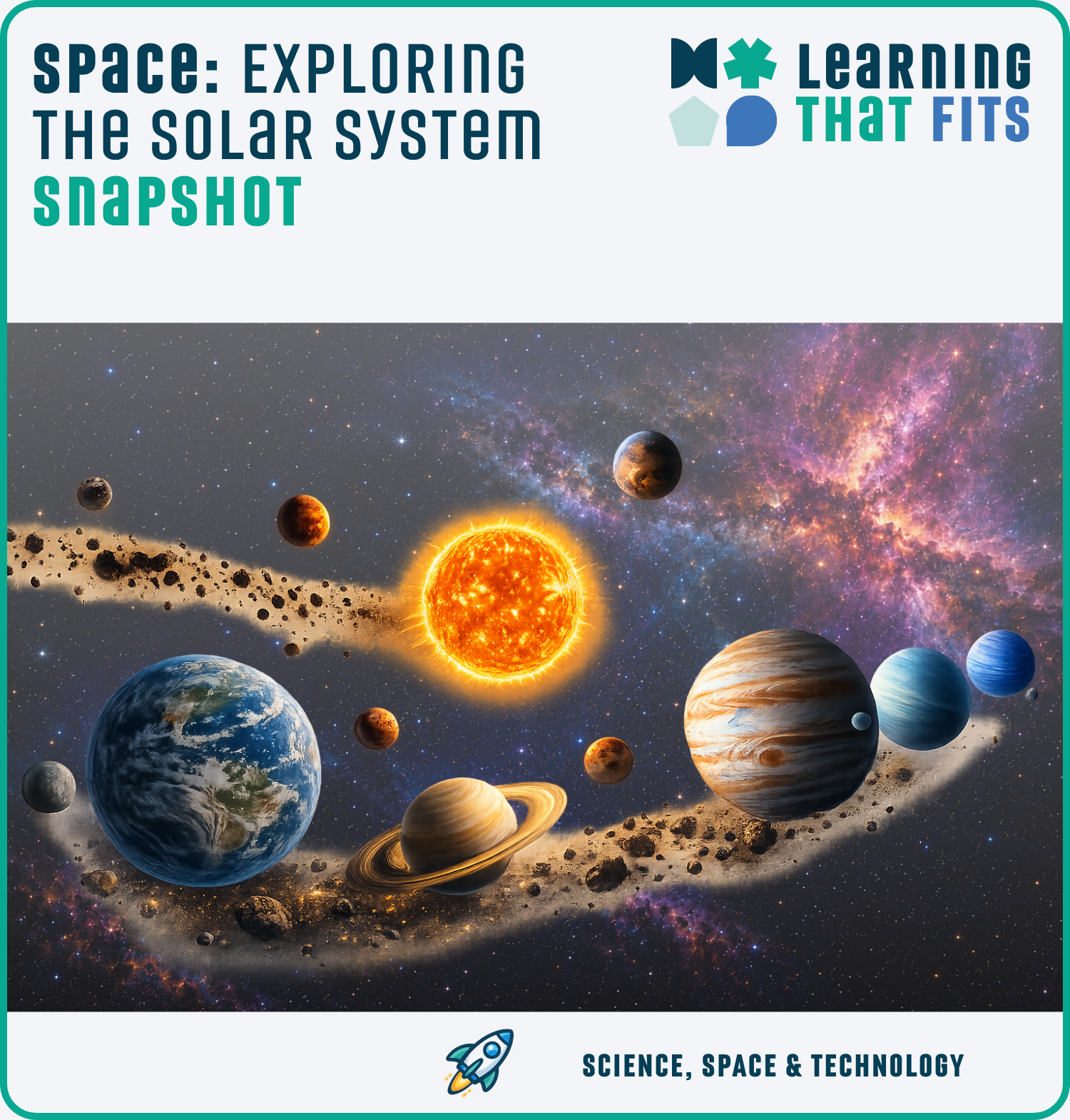
This Curiosity Snapshot introduces the Solar System through science, mathematics, design, technology, and creative inquiry.
Learners explore how the Sun, planets, and moons move through space, how forces affect motion, and how people use technology to explore beyond Earth. Activities encourage curiosity, investigation, problem-solving, and creative thinking while allowing learners to work at their own pace.
The snapshot is designed using inclusive learning principles, supporting diverse learning needs through self-paced exploration, clear instructions, flexible activity options, visual supports, and multiple ways for learners to engage, create, and reflect.
A Curiosity Snapshot is a single learning experience within the larger Curiosity Collection. Each snapshot introduces a topic through exploration, creative activities, and reflection.
The program includes:
| Learning Area | Level, Code | Descriptor |
|---|---|---|
| Science | Level 5–6, VCSSU063 | The Earth is part of a system of planets orbiting around a star (the Sun), and the Moon orbits Earth |
| Science | Level 5–6, VCSSU064 | Light from the Sun reaches Earth and provides the energy needed for life |
| Science | Level 5–6, VCSSU066 | Changes to materials can be reversible or irreversible, and these changes can be caused by heating, cooling, or mixing (used in model building / materials exploration) |
| Science | Level 5–6, VCSSU068 | Forces can affect the motion of objects, and energy can be transferred through different forms |
| Science | Level 5–6, VCSSIS070 | Scientific knowledge is used to solve problems and inform personal and community decisions |
| Science | Level 5–6, VCSSIS071 | Science involves testing predictions by gathering data and using evidence to develop explanations |
| Science | Level 5–6, VCSSIS072 | Scientific understandings, discoveries and inventions are used to solve problems that directly affect people’s lives |
| Mathematics | Level 5–6, VCMNA185 | Use estimation and rounding to check the reasonableness of answers to calculations |
| Mathematics | Level 5–6, VCMNA190 | Choose appropriate units of measurement for length, mass, capacity and time |
| Mathematics | Level 5–6, VCMNA191 | Use scaled instruments to measure and compare lengths, distances, and sizes |
| Mathematics | Level 5–6, VCMNA192 | Compare, order and represent decimals (used when comparing size / distance / scale) |
| Mathematics | Level 5–6, VCMMG200 | Connect volume and capacity and their units of measurement |
| Mathematics | Level 5–6, VCMMG201 | Use simple scales, legends and directions to interpret information (scale models / diagrams / charts) |
| Design and Technologies | Level 5–6, VCDSTC034 | Investigate how people in design and technologies occupations address competing considerations, including sustainability |
| Design and Technologies | Level 5–6, VCDSTS035 | Generate, develop and communicate design ideas using drawings, models and labelled diagrams |
| Design and Technologies | Level 5–6, VCDSCD039 | Investigate how forces and motion are used in designed solutions |
| Digital Technologies | Level 5–6, VCDTDI028 | Examine how digital systems represent and transmit data |
| English | Level 5–6, VCELY366 | Participate in discussions, clarifying and interrogating ideas |
| English | Level 5–6, VCELY367 | Plan, draft and publish texts for different purposes and audiences |
| English | Level 5–6, VCELY368 | Use comprehension strategies to interpret and analyse information texts |
| English | Level 5–6, VCELY369 | Create informative texts using appropriate structure and language |
| Visual Arts | Level 5–6, VCAVAE033 | Explore ideas and artworks from different cultures and times |
| Visual Arts | Level 5–6, VCAVAV035 | Create artworks using different materials, techniques and processes |
| Critical & Creative Thinking | Level 5–6, VCCCTQ022 | Investigate questions and problems using reasoning |
| Critical & Creative Thinking | Level 5–6, VCCCTR025 | Consider alternatives and apply creative thinking to solve problems |
| Personal & Social Capability | Level 5–6, VCPSCSO030 | Work collaboratively in groups to achieve shared goals |
| Personal & Social Capability | Level 5–6, VCPSCSE031 | Reflect on learning and identify strengths and challenges |
Our guided learning journey that moves from curiosity to understanding. Each step
builds naturally, so your child can explore, think, create, and grow at their own pace.

Get orientated and understand the challenge, goals and what you’ll create.


Ask questions, explore different ideas and perspectives and gather inspiration.

Dig deeper into your ideas, test possibilities and build understanding.

Create, make and experiment using the skills and ideas you’ve developed.

Look back on your process and results, celebrate growth and consider what’s next.
Explore legends, creatures, and mythical worlds while building skills
Discover how animals live, adapt, and survive while learning about the natural world.
Use gaming worlds to strengthen problem-solving, digital literacy, and thinking.
Discover the science behind speed while developing skills in physics, measurement, and data.