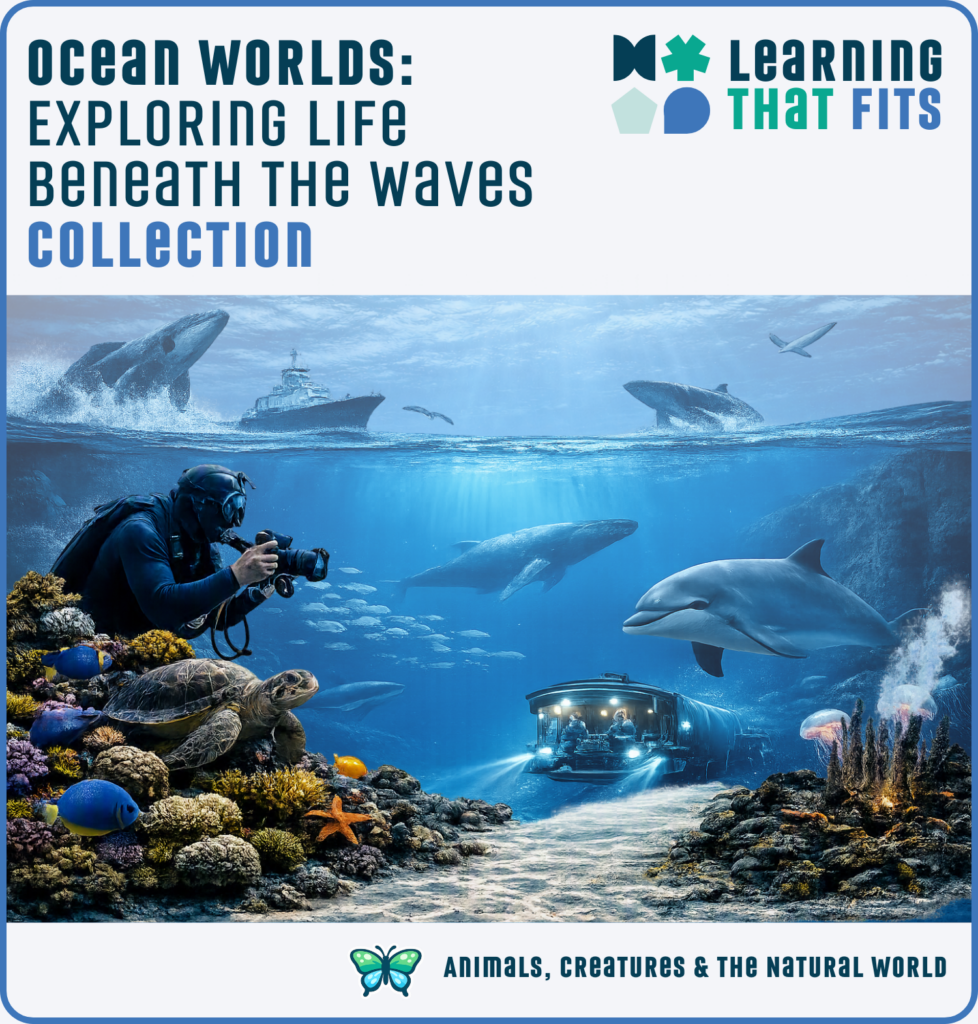
This Curiosity Collection extends the learning from the Ocean Worlds: Life Beneath the Waves Snapshot through a cross-curriculum exploration of the world’s oceans using science, geography, English, mathematics, Aboriginal and Torres Strait Islander perspectives, creativity, and inquiry.
Learners investigate the five oceans, ocean zones, marine ecosystems, food chains, and the remarkable animals that live beneath the waves while discovering how scientists observe, measure, compare, organise, and interpret information about the natural world. They use mathematics to measure and compare ocean animals, collect and represent data, explore stories connected to the sea, and develop an understanding of how Aboriginal and Torres Strait Islander Peoples have cared for Sea Country for thousands of years.
Throughout the Collection, Wonder Seekers build their understanding of the connections between ocean environments, marine life, and people. They explore how living things depend on one another, investigate the importance of healthy oceans, and bring their discoveries together in a creative Ocean Discovery Museum project.
Along the way, learners develop skills in observation, questioning, scientific inquiry, geographical thinking, measurement, data representation, comparison, reading comprehension, communication, creativity, and problem-solving.
Each Collection is designed using inclusive learning principles, supporting diverse learning needs through self-paced exploration, clear instructions, flexible activity options, visual supports, and multiple ways for learners to engage, create, and reflect.
The Collection includes:
Each Curiosity Collection takes learners on a Wonder Learning Journey.
| Learning Area | Level, Code | Descriptor |
|---|---|---|
| English | Level 3, VC2E3LY03 | Use comprehension strategies to build literal and inferred meaning from texts. |
| English | Level 3, VC2E3LE02 | Identify how language features, images and vocabulary are used to represent ideas and engage audiences. |
| English | Level 3, VC2E3LY06 | Create and edit written and multimodal texts for familiar audiences, using appropriate text structures, language features, images and vocabulary. |
| Mathematics | Level 3, VC2M3M01 | Measure and compare the length of objects using metric units. |
| Mathematics | Level 3, VC2M3ST01 | Acquire, record and represent categorical and discrete numerical data using tables, tally marks and graphs. |
| Mathematics | Level 3, VC2M3ST02 | Interpret and compare data displays to answer questions and draw simple conclusions. |
| Mathematics | Level 3, VC2M3N07 | Compare and order numbers and use them to solve practical problems involving measurement and data. |
| Science | Level 3, VC2S3U01 | Compare characteristics of living and non-living things and examine how the characteristics of living things enable them to survive in their environments. |
| Science | Level 3, VC2S3U02 | Describe how living things depend on each other and the environment to survive. |
| Science | Level 3, VC2S3I01 | Pose questions, make predictions and plan simple investigations. |
| Science | Level 3, VC2S3I02 | Observe, measure and record data, using simple equipment and appropriate representations. |
| Science | Level 3, VC2S3I03 | Compare observations with predictions and communicate ideas using scientific representations. |
| Humanities – Geography | Level 3, VC2HG3K02 | Describe the characteristics of places, including natural features and environments, and how people care for and value places. |
| Humanities – Geography | Level 3, VC2HG3S01 | Collect, record and represent geographical information and data from observations, maps and other sources. |
| Humanities – Geography | Level 3, VC2HG3S02 | Interpret information from maps, tables, photographs and other geographical representations to identify patterns and describe places. |
| Humanities – Geography | Level 3, VC2HG3S03 | Draw simple conclusions and communicate geographical ideas using maps, tables, graphs and appropriate geographical language. |
| Humanities – History | Level 3, VC2HH3K07 | Explore perspectives and knowledge of Aboriginal and Torres Strait Islander Peoples and their continuing connection to Country and Place. |
| The Arts – Visual Arts | Level 3-4, VC2AV3C01 | Explore ideas and subject matter when creating artworks using visual conventions and materials. |
| The Arts – Visual Arts | Level 3-4, VC2AV3C02 | Create artworks that communicate observations, ideas and experiences using different materials, techniques and processes. |
| Design and Technologies | Level 3-4, VC2TDE3P01 | Generate, communicate and refine design ideas for designed solutions for a purpose and audience. |
| Design and Technologies | Level 3-4, VC2TDE3P02 | Produce designed solutions using suitable materials, tools and equipment safely. |
| Personal and Social Capability | Level 3-4, VC2PSC3S01 | Describe personal strengths and achievements and identify strategies to support learning and participation. |
| Personal and Social Capability | Level 3-4, VC2PSC3C01 | Contribute to group activities by listening to others, sharing ideas and working cooperatively towards shared goals. |
| Critical and Creative Thinking | Level 3-4, VC2CCT3I01 | Pose questions, identify information needed and generate ideas to investigate familiar problems and situations. |
| Critical and Creative Thinking | Level 3-4, VC2CCT3I02 | Organise information, identify patterns and make connections to draw conclusions and generate possible solutions. |
Our guided learning journey that moves from curiosity to understanding. Each step
builds naturally, so your child can explore, think, create, and grow at their own pace.

Get orientated and understand the challenge, goals and what you’ll create.


Ask questions, explore different ideas and perspectives and gather inspiration.

Dig deeper into your ideas, test possibilities and build understanding.

Create, make and experiment using the skills and ideas you’ve developed.

Look back on your process and results, celebrate growth and consider what’s next.
Explore legends, creatures, and mythical worlds while building skills
Discover how animals live, adapt, and survive while learning about the natural world.
Use gaming worlds to strengthen problem-solving, digital literacy, and thinking.
Discover the science behind speed while developing skills in physics, measurement, and data.