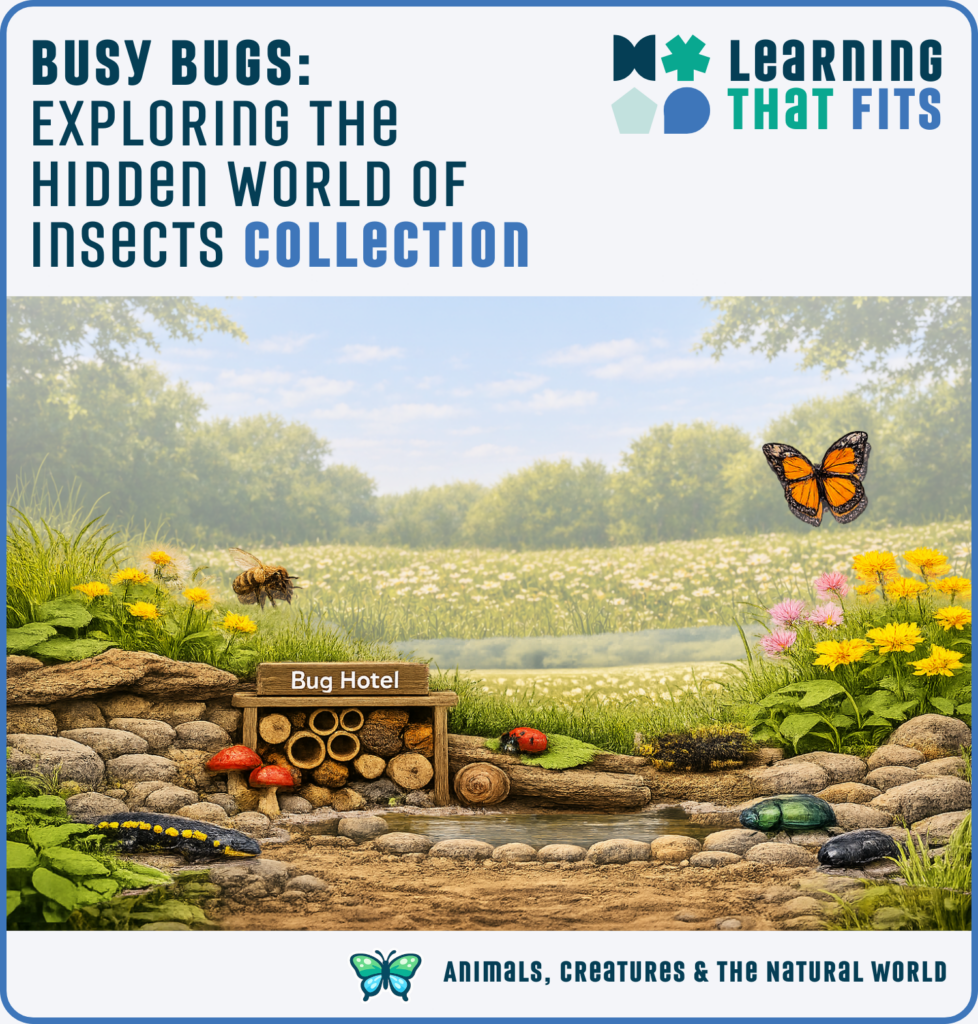
This Curiosity Collection extends the learning from the Busy Bugs: Homes and Habitats Curiosity Snapshot through a cross-curriculum exploration of insects and other minibeasts using science, environmental education, mathematics, English, design, creativity, and inquiry.
Learners investigate bug body features, life cycles, adaptations, and amazing abilities while discovering how scientists observe, compare, measure, classify, and record information about living things. They use mathematics to identify patterns and organise data, apply creative thinking to solve design challenges, and develop communication skills by recording observations, explaining ideas, and presenting discoveries in a variety of ways.
Throughout the Collection, Wonder Seekers build their understanding of how insects grow, survive, and interact with the natural world. They also explore how people can create environments that support bugs and other wildlife before bringing their discoveries together in a creative Welcome to Bug Town project.
Along the way, learners develop skills in observation, questioning, scientific inquiry, measurement, data representation, comparison, problem-solving, creativity, and communication.
Each Collection is designed using inclusive learning principles, supporting diverse learning needs through self-paced exploration, clear instructions, flexible activity options, visual supports, and multiple ways for learners to engage, create, and reflect.
The Collection includes:
Each Curiosity Collection takes learners on a Wonder Learning Journey.
| Learning Area | Level, Code | Descriptor |
|---|---|---|
| English | Level 3, VC2E3LY03 | Use comprehension strategies to build literal and inferred meaning from texts. |
| English | Level 3, VC2E3LY06 | Create written and/or multimodal texts to express ideas, report information, describe experiences, or present imaginative ideas for different purposes and audiences. |
| English | Level 3, VC2E3LA02 | Build and use vocabulary from a range of contexts, including curriculum learning areas, and understand how new vocabulary helps communicate ideas precisely. |
| Mathematics | Level 3, VC2M3M01 | Measure and compare the length of objects using metric units. |
| Mathematics | Level 3, VC2M3ST02 | Interpret and compare data displays to answer questions and describe simple patterns or trends. |
| Science | Level 3, VC2S3U01 | Compare characteristics of living and non-living things and examine the relationships between living things and their habitats. |
| Science | Level 3, VC2S3U02 | Explain how the observable features of living things help them survive in their environments. |
| Science | Level 3, VC2S3I01 | Pose questions and make predictions based on observations and prior knowledge. |
| Science | Level 3, VC2S3I02 | Safely use equipment to make observations and measurements, record data, and represent findings in different ways. |
| Science | Level 3, VC2S3I03 | Compare findings with predictions and identify what has been learned from an investigation. |
| Humanities – Geography | Level 3, VC2HG3K02 | Describe the characteristics of places and environments and how they support the lives of people, plants and animals. |
| Design and Technologies | Level 3, VC2TDE3P01 | Generate, communicate and evaluate design ideas for designed solutions that meet needs or opportunities. |
| Design and Technologies | Level 3, VC2TDE3P02 | Select and use suitable materials, tools and techniques to safely produce designed solutions. |
| Humanities – Geography | Level 3, VC2HG3S02 | Interpret information and data to identify spatial distributions, patterns and simple relationships, and draw conclusions. |
| The Arts – Visual Arts | Level 3-4, VC2AVA3C01 | Experiment with visual conventions, materials, techniques and processes to communicate ideas, observations and experiences. |
| Health and Physical Education | Level 3-4, VC2HP3P05 | Investigate how people can contribute to healthy and sustainable environments. |
| Critical and Creative Thinking | Level 3-4, VC2CCT3S02 | Generate, develop and evaluate ideas and possibilities using imagination, curiosity and evidence. |
| Personal and Social Capability | Level 3-4, VC2PSC3S02 | Work independently and collaboratively to complete tasks, reflect on learning, and respond to challenges. |
Our guided learning journey that moves from curiosity to understanding. Each step
builds naturally, so your child can explore, think, create, and grow at their own pace.

Get orientated and understand the challenge, goals and what you’ll create.


Ask questions, explore different ideas and perspectives and gather inspiration.

Dig deeper into your ideas, test possibilities and build understanding.

Create, make and experiment using the skills and ideas you’ve developed.

Look back on your process and results, celebrate growth and consider what’s next.
Explore legends, creatures, and mythical worlds while building skills
Discover how animals live, adapt, and survive while learning about the natural world.
Use gaming worlds to strengthen problem-solving, digital literacy, and thinking.
Discover the science behind speed while developing skills in physics, measurement, and data.