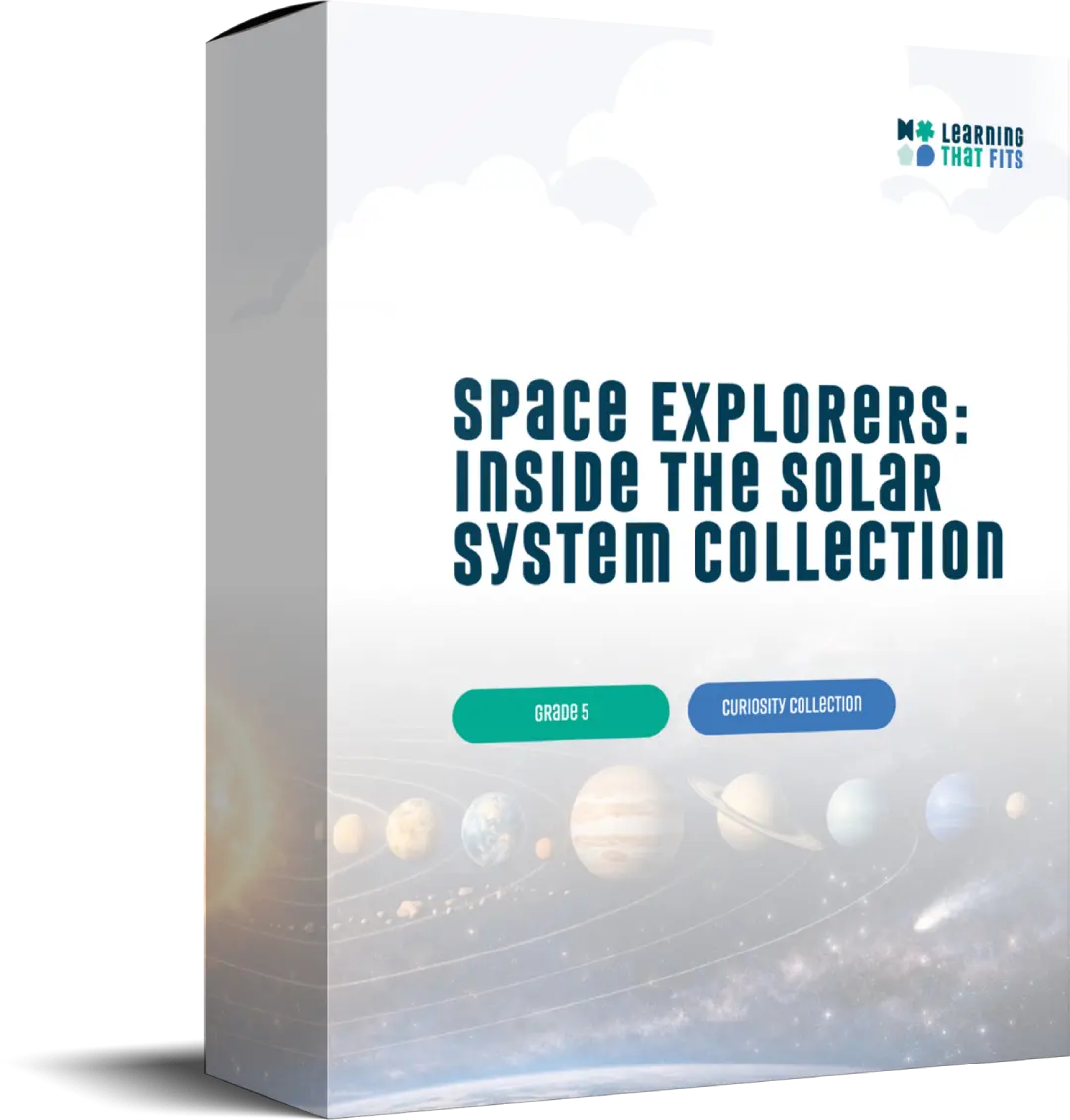
This Curiosity Collection explores the Solar System in greater depth through science, mathematics, design, and inquiry learning.
Learners investigate how the Solar System formed, how objects move in space, how scientists collect and organise information, and how technology is used to explore planets and moons. Activities encourage observation, measurement, problem-solving, and creative thinking while allowing learners to explore ideas in different ways.
The collection is designed using inclusive learning principles, supporting diverse learning needs through self-paced exploration, clear instructions, flexible activity options, visual supports, and multiple ways for Wonder Seekers to engage, create, build, and reflect.
A Curiosity Collection includes multiple Wonder activities completed over several sessions.
Each activity introduces new ideas through exploration, investigation, and creative design, leading to a final project where Wonder Seekers combine what they have learned.
The Collection includes:
| Learning Area | Level, Code | Descriptor |
|---|---|---|
| Science | Level 5–6, VCSSU063 | The Earth is part of a system of planets orbiting around a star (the Sun), and the Moon orbits Earth |
| Science | Level 5–6, VCSSU067 | Forces can be exerted by one object on another through direct contact or from a distance |
| Science | Level 5–6, VCSIS068 | With guidance, pose questions to clarify practical problems or inform a scientific investigation, and predict what the findings of an investigation might be |
| Science | Level 5–6, VCSIS070 | Construct and use a range of representations, including tables and graphs, to represent and describe observations, patterns or relationships in data |
| Science | Level 5–6, VCSIS071 | Compare data with predictions and use as evidence in developing explanations |
| Science | Level 5–6, VCSIS072 | Communicate ideas, explanations and processes using scientific representations in a variety of ways, including multi-modal texts |
| Mathematics | Level 5–6, VCMNA181 | Solve problems involving the comparison of lengths and distances using appropriate units |
| Mathematics | Level 5–6, VCMNA187 | Use scaled instruments to measure and compare length, mass, capacity and time |
| Mathematics | Level 5–6, VCMNA188 | Interpret, compare and use scale on simple maps and models |
| Mathematics | Level 5–6, VCMNA183 | Interpret and compare a range of data displays, including tables and graphs |
| Design & Technologies | Level 5–6, VCDSCD034 | Generate, develop and communicate design ideas and processes using appropriate technical terms and graphical representation techniques |
| Design & Technologies | Level 5–6, VCDSCD035 | Select and use materials, components, tools and equipment safely to produce designed solutions |
| Digital Technologies | Level 5–6, VCDTDI028 | Acquire, store and validate different types of data, and use a range of software to interpret and visualise data |
| English | Level 5–6, VCELY366 | Plan, draft and publish imaginative, informative and persuasive texts demonstrating increasing control over text structures and language features |
| Critical & Creative Thinking | Level 5–6, VCCCTQ023 | Investigate questions and problems using reasoning and inquiry |
Our guided learning journey that moves from curiosity to understanding. Each step
builds naturally, so your child can explore, think, create, and grow at their own pace.

Get orientated and understand the challenge, goals and what you’ll create.


Ask questions, explore different ideas and perspectives and gather inspiration.

Dig deeper into your ideas, test possibilities and build understanding.

Create, make and experiment using the skills and ideas you’ve developed.

Look back on your process and results, celebrate growth and consider what’s next.
Explore legends, creatures, and mythical worlds while building skills
Discover how animals live, adapt, and survive while learning about the natural world.
Use gaming worlds to strengthen problem-solving, digital literacy, and thinking.
Discover the science behind speed while developing skills in physics, measurement, and data.