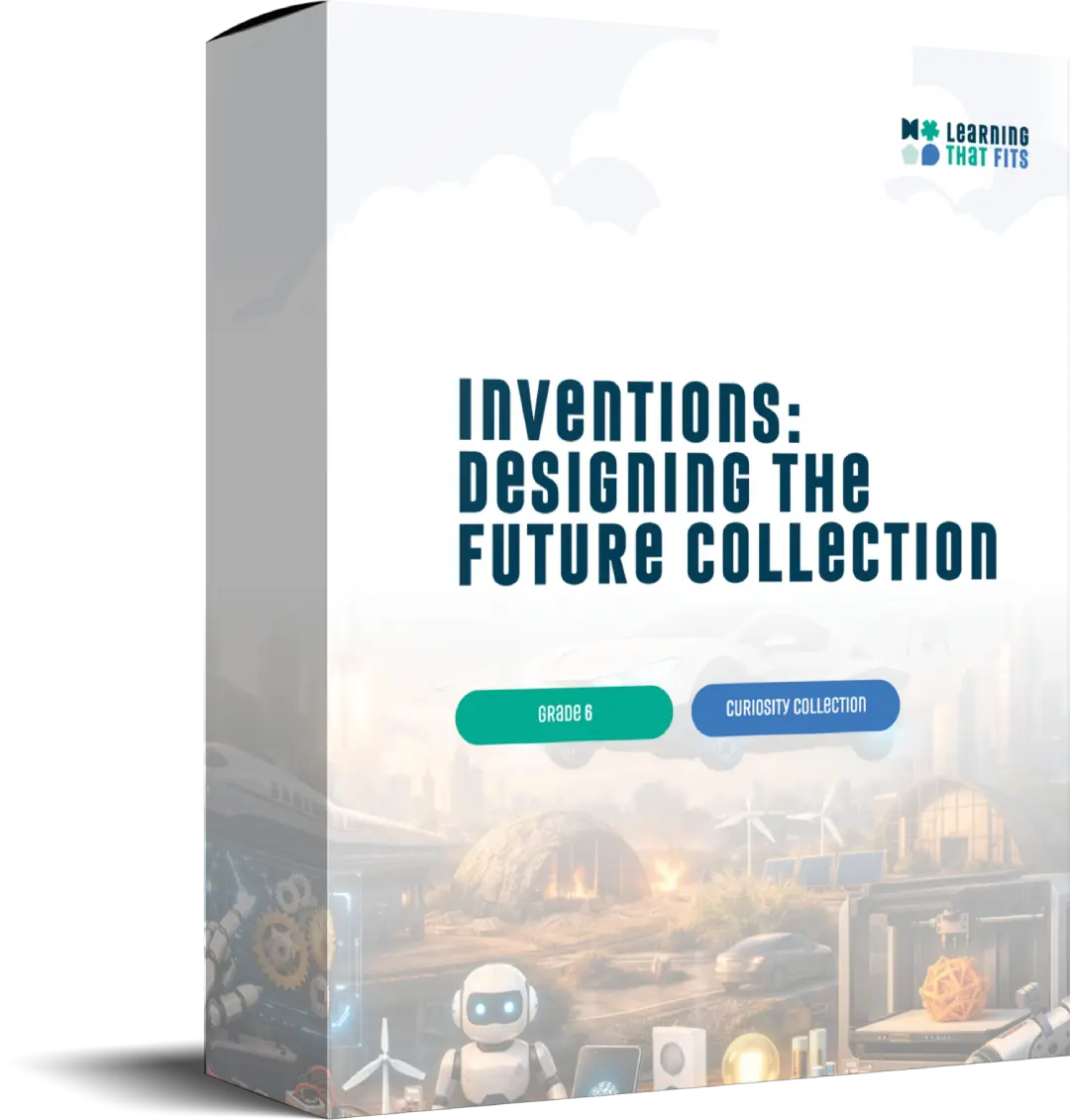
This Curiosity Collection provides a deeper, cross-curriculum exploration of inventions through science, design, technology, and inquiry-based learning.
Learners extend their understanding by exploring how inventions develop over time, how systems and parts work together, and how inventions are used in different contexts. They investigate how ideas are tested, improved, and adapted, and how inventions can influence people, communities, and environments.
The collection introduces learners to design thinking by exploring how inventions are created for different users and purposes, how materials and systems are selected, and how ideas are refined through testing and comparison. Learners are supported to think critically about how inventions work, how they are used, and how they can be improved.
Activities encourage curiosity, investigation, and creative problem-solving while allowing learners to work at their own pace.
Learners may explore ideas in different ways, record their thinking using diagrams or notes, and develop their own invention through a process of design, testing, and improvement.
The collection is designed using inclusive learning principles, supporting diverse learning needs through self-paced exploration, clear instructions, flexible activity options, visual supports, and multiple ways for Wonder Seekers to engage, create, build, and reflect.
A Curiosity Collection includes multiple Wonder activities completed over several sessions.
Each activity introduces new ideas through exploration, investigation, and creative design, leading to a final project where Wonder Seekers combine what they have learned.
The Collection includes:
| Learning Area | Level, Code | Descriptor |
|---|---|---|
| Science | Level 6, VCSSU080 | Scientific understanding is used to explain how changes to materials, forces or energy systems affect their behaviour and can be applied to solve problems. |
| Science | Level 6, VCSIS082 | Plan and conduct investigations, including identifying variables to be changed and measured, and describing potential safety risks. |
| Science | Level 6, VCSIS083 | Use appropriate methods, including tables and simple graphs, to represent data and identify patterns or relationships. |
| Science | Level 6, VCSIS084 | Compare data with predictions and use as evidence in developing explanations. |
| Science | Level 6, VCSIS085 | Communicate ideas and explanations using scientific representations and language. |
| Design & Technologies | Level 6, VCDSTS034 | Investigate how and why food and fibre are produced in managed environments and how these can become more sustainable. |
| Design & Technologies | Level 6, VCDSTS035 | Investigate how forces or electrical energy can control movement, sound or light in a designed product or system. |
| Design & Technologies | Level 6, VCDSCD038 | Generate, develop, and communicate design ideas and processes using appropriate technical terms and graphical representation techniques. |
| Design & Technologies | Level 6, VCDSCD039 | Develop project plans that include consideration of resources when making designed solutions. |
| Design & Technologies | Level 6, VCDSCD040 | Evaluate design ideas, processes, and solutions based on criteria for success. |
| Design & Technologies | Level 6, VCDSCD041 | Plan and manage production processes to safely make designed solutions. |
| Mathematics | Level 6, VCMSP235 | Construct, interpret and compare a range of data displays, including tables and graphs, to represent data and identify patterns. |
| Mathematics | Level 6, VCMNA213 | Solve problems involving the comparison of lengths, areas, volumes, capacities, masses and temperatures. |
| Mathematics | Level 6, VCMNA214 | Solve problems involving the use of percentages and ratios in practical contexts. |
| English | Level 6, VCELY366 | Plan, rehearse and deliver presentations, selecting and sequencing appropriate content and multimodal elements for defined audiences and purposes. |
| English | Level 6, VCELY367 | Use interaction skills, including paraphrasing, questioning and interpreting ideas. |
| English | Level 6, VCELY368 | Analyse and explain how language features, images and vocabulary are used to represent ideas and information. |
| English | Level 6, VCELY369 | Create texts for different purposes and audiences using accurate spelling, grammar and punctuation. |
| Critical & Creative Thinking | Level 6, VCCCTM030 | Examine how problems may contain more than one possible solution and use reasoning to justify choices. |
| Critical & Creative Thinking | Level 6, VCCCTR028 | Investigate different perspectives and generate alternative ideas or solutions. |
| Ethical Capability | Level 6, VCECU010 | Explore ethical issues in contexts such as fairness, sustainability, and the impact of decisions. |
| Intercultural Capability | Level 6, VCICCD011 | Identify and explain how cultural practices influence the use and design of technologies and systems. |
Our guided learning journey that moves from curiosity to understanding. Each step
builds naturally, so your child can explore, think, create, and grow at their own pace.

Get orientated and understand the challenge, goals and what you’ll create.


Ask questions, explore different ideas and perspectives and gather inspiration.

Dig deeper into your ideas, test possibilities and build understanding.
Create, make and experiment using the skills and ideas you’ve developed.

Look back on your process and results, celebrate growth and consider what’s next.
Explore legends, creatures, and mythical worlds while building skills
Discover how animals live, adapt, and survive while learning about the natural world.
Use gaming worlds to strengthen problem-solving, digital literacy, and thinking.
Discover the science behind speed while developing skills in physics, measurement, and data.