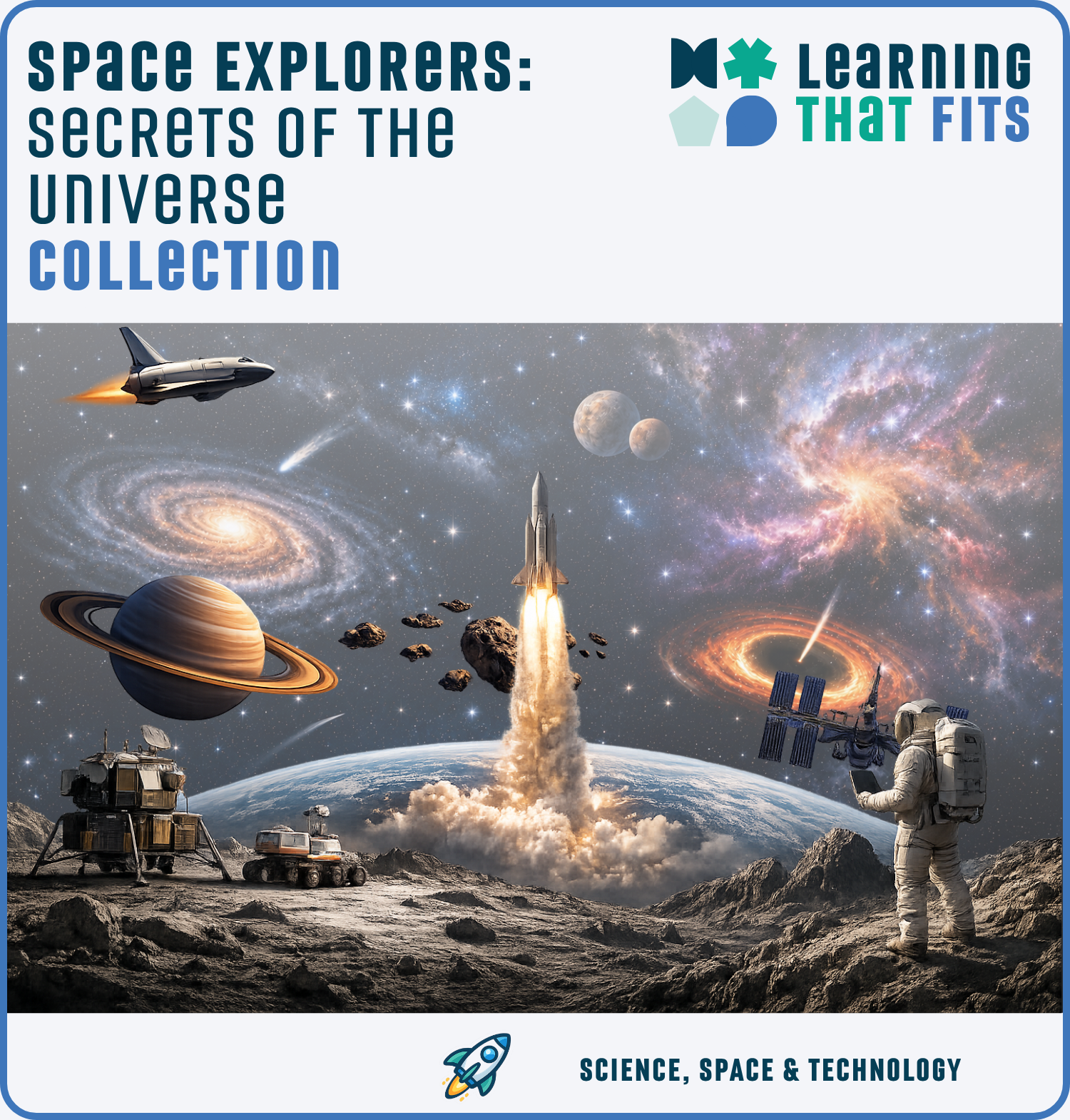
This Curiosity Collection continues the exploration of space beyond the snapshot and provides a cross-curricular learning experience through science, mathematics, design, technology, literacy, and creative inquiry.
Learners explore how space systems are organised, how technology works as part of connected systems, and how scientific knowledge is used to solve problems in space and on Earth. They investigate how space exploration continues today, how new discoveries change our understanding of the universe, and how technologies are developed and applied in different contexts.
Activities encourage questioning, investigation, analysis, and design thinking, supporting learners to explain relationships, compare ideas, and develop solutions.
Learners engage in observing, modelling, and representing ideas while working at their own pace and exploring different ways to learn and communicate their understanding.
The collection is designed using inclusive learning principles, supporting diverse learning needs through self-paced exploration, clear instructions, flexible activity options, visual supports, and multiple ways for Wonder Seekers to engage, create, build, and reflect.
A Curiosity Collection includes multiple Wonder activities completed over several sessions.
Each activity introduces new ideas through exploration, investigation, and creative design, leading to a final project where Wonder Seekers combine what they have learned.
The Collection includes:
| Learning Area | Level, Code | Descriptor |
|---|---|---|
| Science | Level 5–6, VCSSU067 | The Earth is part of a system of planets orbiting around a star (the Sun) in the universe. |
| Science | Level 5–6, VCSSU068 | Light from a source forms shadows and can be absorbed, reflected and refracted. |
| Science | Level 5–6, VCSSU070 | Energy from a variety of sources can be used to generate electricity and power devices. |
| Science | Level 5–6, VCSIS072 | With guidance, plan appropriate investigation methods to answer questions or solve problems. |
| Science | Level 5–6, VCSIS073 | Decide which variables should be changed and measured in fair tests and accurately observe, measure and record data. |
| Science | Level 5–6, VCSIS076 | Construct and use a range of representations, including tables and graphs, to represent and describe observations. |
| Science | Level 5–6, VCSIS078 | Compare data with predictions and use as evidence in developing explanations. |
| Science | Level 5–6, VCSIS079 | Communicate ideas, explanations and processes using scientific representations in a variety of ways. |
| Design and Technologies | Level 5–6, VCDSTS033 | Investigate how people in design and technologies occupations address competing considerations, including sustainability, when designing products, services and environments for preferred futures. |
| Design and Technologies | Level 5–6, VCDSTS034 | Generate, develop and communicate design ideas and processes using annotated sketches, models and appropriate technical terms and graphical representation techniques, including using digital tools. |
| Design and Technologies | Level 5–6, VCDSTS035 | Select appropriate materials, components, tools, equipment and techniques and apply safe procedures to make designed solutions. |
| Design and Technologies | Level 5–6, VCDSTS036 | Negotiate criteria for success that include consideration of sustainability to evaluate design ideas, processes and solutions. |
| Digital Technologies | Level 5–6, VCDTDI028 | Examine how digital systems form networks to transmit data and how the specifications of hardware and software components affect their performance. |
| Digital Technologies | Level 5–6, VCDTDI029 | Acquire, store and validate different types of data and use a range of software to interpret and visualise data to create information. |
| Mathematics | Level 5–6, VCMSP235 | Pose questions and collect categorical or numerical data by observation or survey. |
| Mathematics | Level 5–6, VCMSP237 | Construct, interpret and compare a range of data displays, including tables and graphs, for categorical and numerical data. |
| Mathematics | Level 5–6, VCMNA208 | Solve problems involving the comparison of lengths, areas, volumes, capacities and masses using appropriate units. |
| English | Level 5–6, VCELY379 | Plan, draft and publish imaginative, informative and persuasive texts, choosing and experimenting with text structures, language features, images and digital resources appropriate to purpose and audience. |
| English | Level 5–6, VCELY380 | Use comprehension strategies to interpret and analyse information and ideas, comparing content from a variety of textual sources including media and digital texts. |
| English | Level 5–6, VCELY381 | Use interaction skills, including paraphrasing, questioning and interpreting non-verbal cues, to contribute to discussions and clarify meaning. |
| Critical and Creative Thinking | Level 5–6, VCCCTQ023 | Examine how different kinds of questions can be used to identify and clarify information, ideas and possibilities. |
| Critical and Creative Thinking | Level 5–6, VCCCTQ024 | Identify and explain how ideas can be changed, developed and improved by testing, modifying and refining them. |
| Critical and Creative Thinking | Level 5–6, VCCCTR025 | Investigate different possibilities and make reasoned choices based on evidence and criteria. |
| Personal and Social Capability | Level 5–6, VCPSCSE026 | Describe the influence that people and groups have on the development of personal identity. |
| Personal and Social Capability | Level 5–6, VCPSCSE027 | Identify how personal strengths and achievements contribute to a sense of identity and wellbeing. |
| Personal and Social Capability | Level 5–6, VCPSCSE028 | Practise skills to work independently and collaboratively to achieve goals. |
Our guided learning journey that moves from curiosity to understanding. Each step
builds naturally, so your child can explore, think, create, and grow at their own pace.

Get orientated and understand the challenge, goals and what you’ll create.


Ask questions, explore different ideas and perspectives and gather inspiration.

Dig deeper into your ideas, test possibilities and build understanding.

Create, make and experiment using the skills and ideas you’ve developed.

Look back on your process and results, celebrate growth and consider what’s next.
Explore legends, creatures, and mythical worlds while building skills
Discover how animals live, adapt, and survive while learning about the natural world.
Use gaming worlds to strengthen problem-solving, digital literacy, and thinking.
Discover the science behind speed while developing skills in physics, measurement, and data.